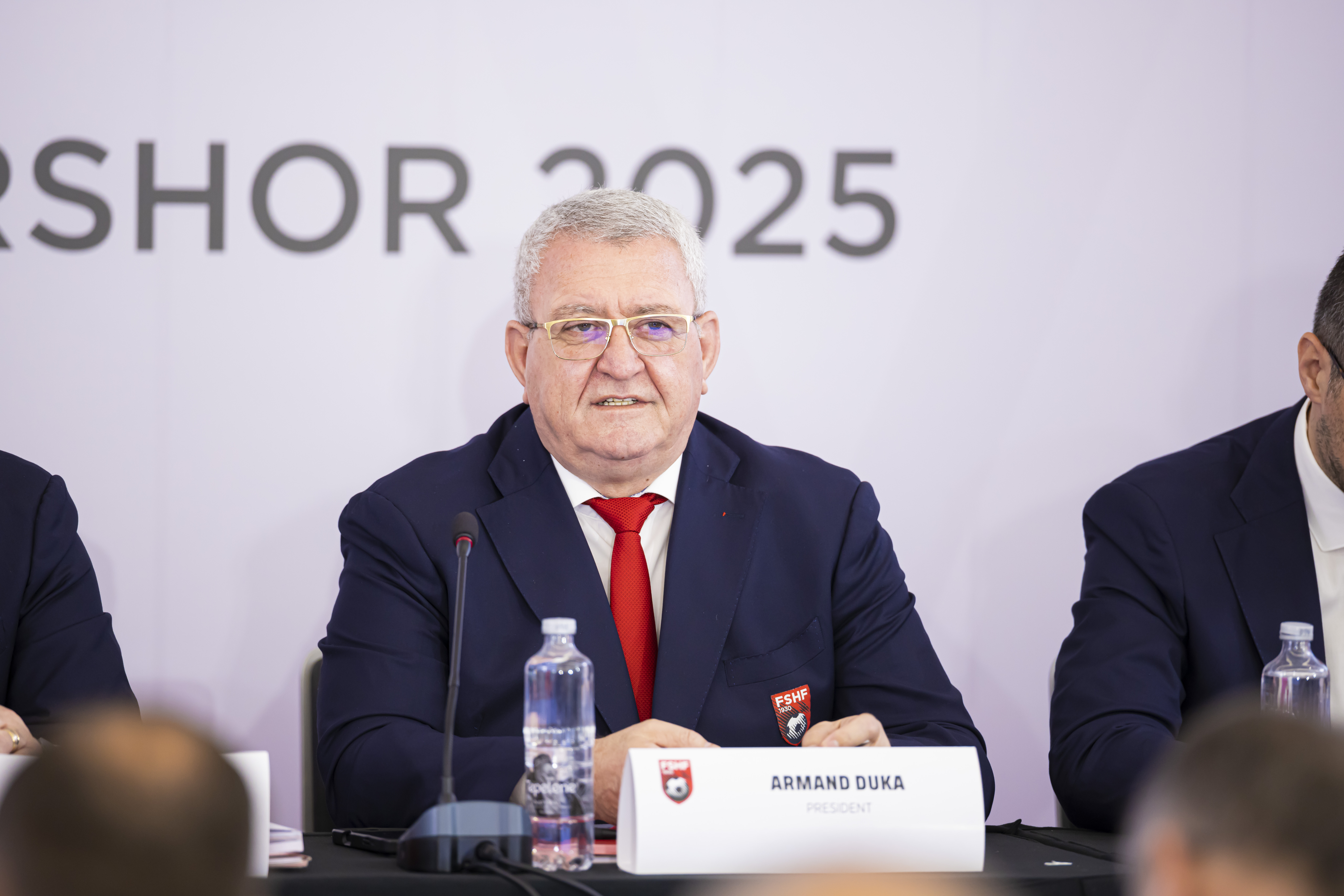
The 2025 Ordinary General Assembly of the Albanian Football Asociation held its proceedings this Wednesday at the “House of Football,” bringing together all representative structures of Albanian football.
Under the leadership of President Armand Duka and the members of the FSHF Executive Committee, the Assembly was attended not only by representatives of the member associations but was also honored by the presence of FIFA representative Marco Ferri, UEFA representative Jozef Kliment, as well as the Minister of Education and Sports, Ms. Ogerta Manastirliu.
Below is the full speech of President Armand Duka during the Ordinary General Assembly of the FSHF:
“Dear friends and guests,
Honorable Minister Manastirliu,
Honorable Marco,
Honorable Jozef,
Dear members of our Assembly,
“It is always a pleasure and privilege for me to welcome you to the AFA General Assembly, which is, without the slightest doubt, one of the most historic and successful periods for our association.
In this brief welcoming and reflective speech, I won’t go into detail, as those are included in today’s agenda — every expense, every revenue, and every AFA activity from the past year has been explained and will be voted on by you, along with the proposed budgets for 2025 and 2026.
Let me begin with one of the most beautiful events of the past year. For the second time in our 95-year history, and within just eight years, we qualified for the finals of a European Championship, finishing first in our qualifying group.
The draw placed us against strong opponents: the reigning European champions, Italy; the World Cup runners-up, Croatia; and the eventual winners of the European Championship, Spain.
Everything was prepared with great care and professionalism by the AFA administration. The organization, accommodation, and all other aspects met the high standards expected of such a prestigious tournament. The team held its preparatory phase in Austria and then in Germany. Our training centers provided all the necessary conditions for accommodation and preparation, allowing the team to feel at their best and give their maximum on the field.
The fastest goal in European Championship history, scored by our player Nedim Bajrami in the 23rd second of the match against Italy, is a moment that will forever remain in the history of European and world football. It was accompanied by the team’s dignified performance against Croatia and the fantastic support of the Albanian fans, who were always there to lift the National Team.
In the second half of the year, the National Team participated for the second time in League B of the UEFA Nations League, in a balanced group with the Czech Republic, Ukraine, and Georgia. Up until the final match against Ukraine, we had a real chance to win the group, but a positive result eluded us at the decisive moment.
Ultimately, we finished fourth with 7 points — the highest total of any team placed fourth in the League B groups. This edition showed a high level of competition, and even though we didn’t achieve our goal, we remained in the race until the final seconds, in a group where everything was decided by the smallest details.
The qualifiers for the 2026 World Cup in the USA placed us in an extremely difficult group with opponents such as England, Serbia, Latvia, and Andorra. After four matches, we’ve collected 5 points and currently sit in second place. Against Serbia and Latvia, we showed character, courage, and quality — even if the results didn’t fully reflect our performance.
We are still in the race — no longer as favorites, and fully aware of the challenges that lie ahead. But the team will fight until the final match against England in Tirana, hoping that it will be a decisive final. I have full confidence in our players, the AFA’s technical and administrative staff, and in the public that supports us unconditionally.
I am deeply grateful and will forever be thankful to the players of our National Team for the unforgettable emotions they’ve given us.
Neither they nor we seek to be called ‘heroes’ when we win, nor ‘traitors’ when we lose — especially by those who claim the right to call themselves ‘patriots’. We are simply a team that gives its all in a beautiful game, where victory, draw, or loss are part of the process. Criticism is natural after a defeat, but it should not be an eagerly awaited moment to unleash resentment in the name of nationalism or patriotism.
Perhaps I focused a bit more on the senior National Team, but 2024 has been just as dynamic and fruitful for our other national teams, with solid progress at all levels.
The Women’s National Team, led by Coach Grima, performed admirably in League C of the Nations League, finishing first in the group and securing promotion to League B, where in 2025 they placed third, achieving two important wins against Croatia.
For the first time in history, the Women’s National Team came very close to the dream of qualifying for the European Championship finals, clearly reflecting the seriousness and continuity of the work being done with this team, which is being built with ever higher standards.
Likewise, the youth teams for boys are affirming themselves as important sources for the future. The U-21 National Team has become an effective bridge to the senior team, with players now finding space at the highest levels.
The U-19 and U-17 teams — for both boys and girls — are following the same developmental path, building a solid continuity with a clear focus on raising quality and bringing new talent closer to the elite. Meanwhile, the U-17 National Team’s participation in the 2025 European Championship finals was a valuable experience for both the players and all of us.
The growth of our national teams is no coincidence, but the result of structured and dedicated work at every level.
Alongside on-field progress, we have significantly strengthened our profile as a host country in the European arena. In the past year alone, we hosted 11 official UEFA tournaments, while in the first half of this year, 5 have already been held and 7 more are scheduled by year’s end. These tournaments help us not only in a sporting sense but also financially and in terms of national promotion. This progress is not just statistical — it’s a testament to a partnership built on trust, professionalism, and high standards.
The U-17 Championship attracted a satisfying number of spectators in the stands, with an average of 4,700 spectators per match — making it the second most attended U-17 European Championship after Germany’s 2018 record of 5,500 spectators per match.
For this event, we invested over €5.4 million in infrastructure, with major renovations at the “Egnatia Arena,” “Elbasan Arena,” “Niko Dovana,” and a new pitch at the House of Football. We also reconstructed the pitches of: “Selman Stërmasi,” “Skënder Halili,” “Roza Haxhiu,” “Tofik Jashari,” “Luzi i Vogël,” and the “Tropikal” complex — all of which were essential for the teams’ training sessions and are now valuable assets for Albanian football.
In fact, when we applied to host this tournament, we had a financial support promise from the Ministry of Education and Sports, which has not yet materialized. We hope that in the coming days, the Ministry fulfills this commitment. Otherwise, future hosting opportunities may be put into question.
Nevertheless, we found strong support from partners such as Vodafone, Credins Bank, Tepelena, Abissnet, Everest, Eurolab, Elka, and T-ticket.
Today, we are not just part of European football — we are a respected voice, a working model, and a worthy partner at the tables where the future of this sport is shaped. In fact, on September 11th of this year, the UEFA Executive Committee will hold its meeting and make important decisions right here in Tirana.
Yesterday, at the Parliamentary Committee, the Ministry of Education and Sports proposed changes to the sports law, without the understanding of any of the stakeholders in sport and with reasoned opposition from our experts. This proposal seeks to create a clientelist, non-independent, and unprofessional sports arbitration body.
On behalf of the largest sports organization in the country, I call for reflection from the Ministry, the Parliamentary Committee, and Parliament itself, not to pass this law. Instead, let us cooperate with all sports asociations, interest groups, and produce a legislative package that truly serves the development of sport!”
“At the heart of our vision lies the development of professional capacities at all levels.
Through a broad network of training courses and international experience exchanges, we are preparing coaches and specialists in line with UEFA standards.
During this period, we have organized 24 different training courses with a total of 684 graduates, as well as the second edition of the UEFA CFM program, aimed at improving the professional and managerial skills of AFA and club officials.
Alongside our engagement with the national teams and international scene, the development of domestic competitions remains a fundamental pillar of our strategy. The current season has seen noticeable improvements in quality, organization, and public interest, thanks to improved formats and continuous efforts across boys’ and girls’ championships at all levels. These achievements are the result of close cooperation with clubs, associations, and local actors who play a key role in promoting young talents.
The new “Final Four” format, despite early criticism and skepticism, brought more excitement and rivalry to the very end. Media coverage increased significantly, stadiums had more spectators, and public interest visibly grew.
In the 2024–2025 season, for both boys and girls, we organized and managed:
-
26 national championships
-
319 participating teams
-
5,515 active players
-
2,783 matches played
-
Officiated by 330 referees, 58 observers, and 85 match delegates
-
With the VAR system applied in 100% of Abissnet Superiore matches and 30% in the First Division
-
Followed by 273,250 spectators in stadiums, marking a 7.7% increase from the previous season
-
A total of 23,374 registered players this season, of which 1,729 are girls, and 2,900 more than the previous season
For the third consecutive year, we financially stimulated the involvement of young players aged 16–21 in the First Division, distributing over 13,289,798 new ALL in the 2024–2025 season alone, with a total of 31,173,554 ALL over three years. Beneficiary clubs include Apolonia, Erzeni, Burreli, Kukësi, Korabi, Kastrioti, Vora, Valbona, Pogradeci, among others.
The refereeing sector has seen a marked improvement in quality and representation, reaching record levels internationally. Albania registered for the first time 19 referees with FIFA badges, including 12 men, 6 women, 1 futsal referee, and 2 UEFA observers.
Albanian officials were involved in 47 international matches. Growth has also been reflected domestically through the Refereeing Academy, the “Become a Referee” campaign, and institutional support from the AFA, which led to a notable increase in active referees — from 301 last season to 327 this season.
At the same time, regular and structured training has improved decision-making, professional conduct, and consistency in rule enforcement at all competition levels. These developments confirm a positive and sustainable transformation of the refereeing system in Albania.
Amateur football, or football for all, is experiencing steady and increasingly visible development, with notable successes at home and abroad — from “Sunday League” to futsal, beach soccer, 5-a-side, and more. Not only these, but also initiatives like the Replay Cup, Playmaker projects for girls aged 5–8, school football in collaboration with the Ministry of Education, and championships for children with disabilities, are turning football into a powerful tool for social inclusion, education, and community engagement.
Our goal is clear:
To build a sustainable football ecosystem that feeds quality at the top, strengthens the grassroots, and gives every player, every club, and every city the opportunity to be part of it!
Beyond developing competitions and engaging communities, FSHF continues to consolidate its operations as an organization, particularly in key areas like finance, commercialization, and sports justice.
In a reality where resources are increasingly limited, we have chosen not to be mere recipients of aid, but creators of opportunity. We have built a functional system where every match organized, every partnership signed, every broadcasting right, every ticket or jersey sold — turns into real value for Albanian football.
In just the past year, we have generated over €7.2 million in revenue,
Of which €2.1 million came from commercial partners.
We completed over 10,000 sales of official merchandise, generating more than €500,000 in income.
We finalized strategic agreements with new partners such as Credins Bank, Western Union, Heatrex GmbH, and Electronic Arts.
Additionally, we signed an important broadcasting rights agreement with RTSH, worth €4.32 million over three years, which is expected to be fully implemented financially in the near future.
The renewal of our relationship with “Abissnet” for the naming rights of the “Abissnet Superiore” championship, and ongoing cooperation with our long-standing partners – Vodafone Albania, SIGAL UNIQA, and Uji i Ftohtë Tepelenë – confirm their trust in the AFA brand and its financial and sporting stability.
All of this clearly proves that when football is led with vision and managed with integrity, it doesn’t become a burden on the system – it becomes a sustainable source of growth that fuels its own development.
These values created are not kept at the center – at the AFA – but are reinvested in:
-
Improving infrastructure
-
Raising technical and managerial standards
-
Supporting social projects
-
Training a new generation of professionals
-
Strengthening competitions
-
Encouraging inclusion at all levels
The income secured through the factors I just mentioned, combined with the support of partners and contributions from the governing bodies of European and world football – UEFA and FIFA – has been translated into concrete investments with direct impact on the ground, especially in infrastructure, which is one of the key pillars for the long-term growth of Albanian football.
In the past year alone, the Albanian Football Association implemented one of the largest investment programs in sports infrastructure in its history, with a budget of over €8.5 million. These funds were focused on building and reconstructing stadiums, creating new pitches, improving existing infrastructure, and carrying out major infrastructural upgrades in preparation for hosting the UEFA U-17 European Championship.
Of this amount, over €6.2 million were directly invested by AFA, with the remainder in cooperation with our partners. This joint investment approach has doubled the impact of our efforts and led to significant, tangible improvements.
In the same spirit, we have undertaken strategic and technological investments, including:
-
Centralizing the VAR system
-
Launching FSHF TV
-
Upgrading “Air Albania” stadium,
which has helped position Albania at the same technological level as many advanced European football federations.
The Sports Field Maintenance Project has equipped clubs with specialized machinery, technical materials, and training for staff, to improve the national standard of field upkeep.
Now is the time to bring these investments into daily life.
Sports infrastructure is not enough to simply build – it must be maintained, it must function, and it must serve!
Clubs and municipalities must take responsibility to keep this progress alive. Only through shared commitment can sports investment become a sustainable development policy.
The sporting justice bodies – the Disciplinary and Ethics Committee and the National Dispute Resolution Chamber – have ensured, and will continue to ensure, a fair and trustworthy environment for all parties, by enforcing rules with strict adherence and integrity.
For this edition, the Disciplinary and Ethics Commission has handled 1,413 cases.
> The National Dispute Resolution Chamber (DHZKM) has issued 22 decisions regarding disputes between clubs and players, providing a fast and impartial resolution mechanism.
> The Training Compensation Commission has approved 15 decisions, increasing efficiency in compensating clubs for player development.
Another important objective remains the impact through the game on improving the stability of life and society. We have organized a series of community events such as “Pink October,” the Diplomatic Cup, activities for International Women’s Day, as well as awareness matches in cooperation with organizations like “Autizmi Flet,” UNHCR, UN Women, Caritas Albania.
Championships have also been held for children with disabilities and seminars on human rights, anti-racism, and women’s empowerment. Additionally, we have signed cooperation agreements with UNICEF and the Commissioner for Protection against Discrimination, further strengthening AFA’s inclusive approach at all levels of football.
In the field of environmental sustainability, we have invested in the installation of photovoltaic panels at the Football House and at the “Air Albania” stadium, producing electrical energy, nearly reducing energy costs to zero and cutting 134 tons of carbon dioxide – equivalent to planting 7,353 trees.
This commitment was widely appreciated by UEFA and representatives of 55 European federations, where Albania was recognized as a positive example in Europe for its progressive approach to social and environmental issues.
We have consolidated the volunteer network and youth engagement programs. I proudly emphasize that we are one of the rare institutions in Albania supported by a structured network of volunteers. During this period, 90 volunteers have been activated in three matches of the Senior National Team, as well as in organizing the UEFA U-17 European Championship.
Also, we have developed 45 internship programs, creating real opportunities for young people to get to know the football structures closely and to develop their professional skills.
Dear members,
In the coming months and years, great challenges and bold objectives await us.
With the national teams:
We will continue to dream of a historic qualification to the World Cup – if not in 2026, then in 2030.
We will aim to qualify for the 2028 European Championship.
We will aim to pass the group stage in EURO 2027 for the U-21 team.
We will aim for qualification to the “Elite Round” with the U-17 and U-19 teams.
We will work with the senior women’s team to remain in League B.
Increasing the base of young footballers and the widest possible inclusion of children in our system remains one of the main priorities.
We remain committed to contributing maximally to improving the legal system that supports sustainable sports development, including the sponsorship law.
We will continue with investments in infrastructure, making the most of internal funds, FIFA and UEFA international programs, as well as partnerships with clubs, municipalities, the private sector, and the government.
Currently, concrete investments are in process or planning phase in:
Training fields in Krujë, Gjirokastër, Prrenjas, Librazhd, and Durrës (Katundi i Ri),
Stadiums in Kavajë, Vorë, Përmet, and Gramsh,
The stadiums “Selman Stërmasi,” “Niko Dovana,” Korçë, and Vlorë, which are being developed through private partnerships,
The hotel at the Football House premises,
The ongoing “100 Fields” project.
We will build a modern and transparent model through digitalization of processes, through platforms “My Federation” and COMET, the online portal for the education of coaches and specialists, as well as through UEFA’s “Pitch Mapping,” which will allow standardized analysis of existing infrastructure.
We will increase revenues from commercialization by 30% and in 2026 distribute 3 million euros to clubs of the Superiore and First Category as direct financial support for improving their functioning.
The organization of UEFA EURO U-21 in 2027 constitutes another historic moment for Albania – an opportunity to show that we know how to host and organize big events. Which become big only if we cooperate together.
AFA is determined to push forward the development of Albanian football with commitment, integrity, and long-term vision. But every strategy, every project, every ambition requires more than ideas and plans. It requires will. It requires courage to take decisions and responsibility to carry them through.
We don’t talk about progress. But we lead it! And this starts here, at the Assembly, all together, as always supporting each other, without doubt also criticizing when needed, but always with the aim of moving forward.
Football is nobody’s property, but everyone’s responsibility! It requires mutual trust, concrete cooperation, and joint engagement to make it stronger, fairer, more competitive, more educational, and more inclusive.
You, dear members of AFA, are not just witnesses of this journey – you are its co-authors!
What we build today will directly impact the future of Albanian football. Thanking you sincerely for your trust, I wish you the best in your work at this Assembly.