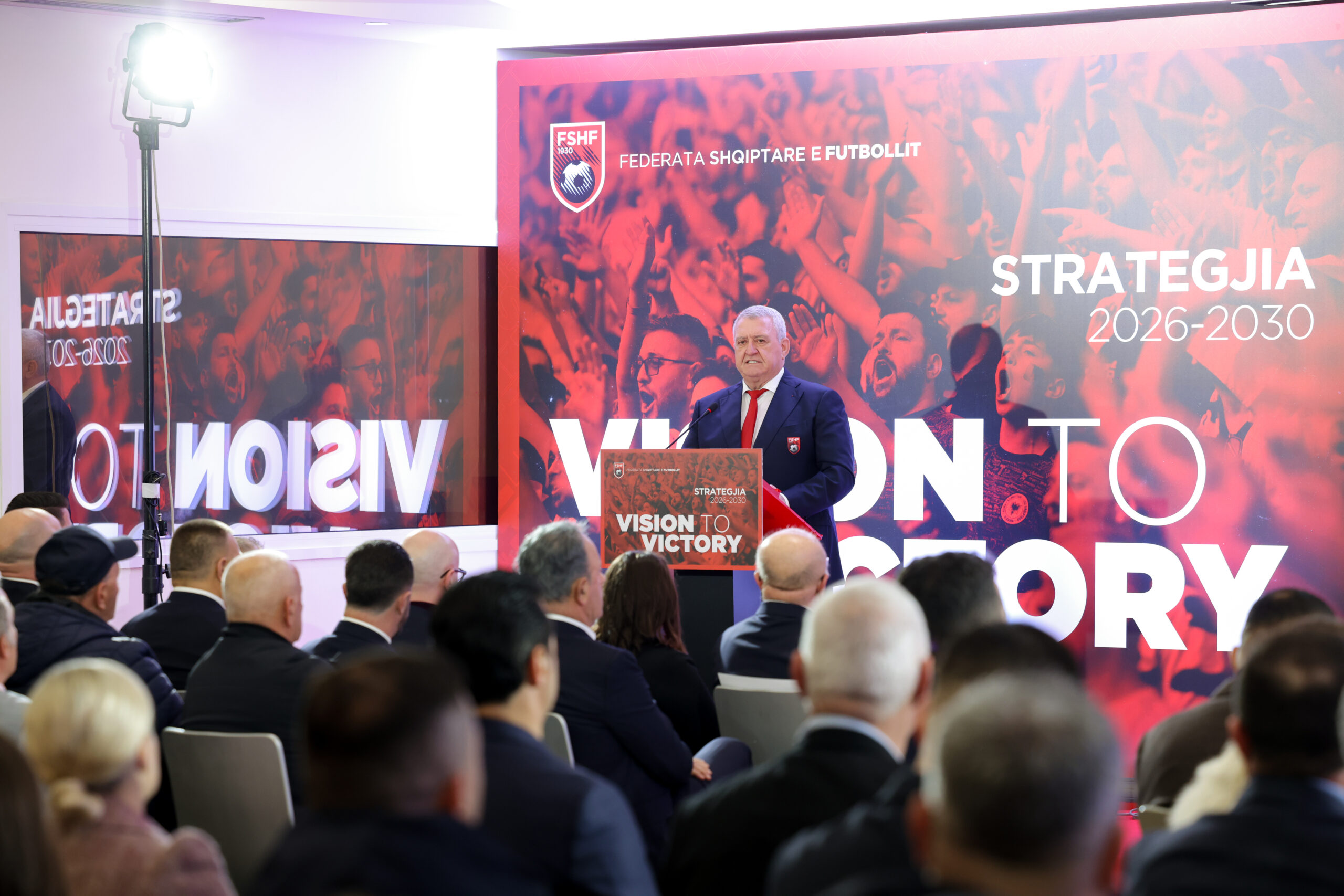
The Football Association organized this Monday the important event presenting the strategy “Vision to Victory 2026–2030.” This strategy includes projects expected to bring qualitative changes to Albanian football over the next four years and has been developed in collaboration with top UEFA experts following extensive research work.
Present at this major and highly significant event for the development and future of Albanian football were the President of the Albanian Football Association, Armand Duka; the Minister of Tourism, Culture and Sport, Blendi Gonxhja; presidents and representatives of Albanian clubs; leaders of Regional Football Associations; members of the football community; well-known former footballers; sponsors; partner organizations; media representatives, and others.
At the event, held at the “House of Football,” the head of Albanian football presented a review of the previous strategy, “Football for the Nation”, emphasizing that 95% of its objectives have been achieved or are in an advanced stage of implementation.
President Duka then unveiled to those present and to the public the strategy for the next four years, “Vision to Victory 2026–2030”, stressing that it represents a clear vision for the development of Albanian football at all levels. The strategy aims to increase participation and quality in football, strengthen organizational structures, and ensure sustainable investments in infrastructure and youth talent development.
“This strategy has been designed to be measurable, implementable, and directly connected to the reality of Albanian football.
By 2030, we aim to reach 26,000 registered male football players, up from the current 24,078, despite the demographic challenges the country faces. This growth will come through expanding programs in schools and communities, strengthening the role of regional associations, direct support for clubs working with youth categories, creating more organized activities for children and young people, improving infrastructure, and continuing projects such as ‘My Jersey’ and ‘Your Ball.’
In terms of infrastructure, by 2030 we aim to add 30 to 40 new football pitches through Association projects, mainly in the Tirana region, where population density is higher. This will help improve the population-to-pitch ratio, which unfortunately is currently unsatisfactory, with one football pitch per 18,981 residents, compared to more developed European countries where the ratio is approximately one pitch per 3,800 residents.
However, the real objective and national necessity is the construction of 200 new football pitches, which cannot be achieved by the Federation alone but requires support from state budgets,” said President Duka. He also emphasized the importance of cooperation with clubs, institutions, and strategic partners, describing this process as the foundation for achieving long-term objectives.
“A very important strategic objective remains increasing the number of spectators in stadium stands across national championships at all levels. This will be achieved in cooperation with professional clubs and academies, assisting them with concrete projects and adopting the same approach used with the senior national team.
Strengthening the financial position of football clubs and academies is also crucial. They are currently facing financial difficulties, and development will be very slow without financial support and incentives, even if temporary. We will continue direct financial support from the Association’s budget, as we have done for 2026 with €3 million, and we will continue working with the Government to finalize the Sports Sponsorship Law. The progress of football and Albanian sport as a whole will be very slow without such a law,” added the AFA President.
President Duka also highlighted the objectives for the men’s and women’s national teams, as well as for the U-21 national team.
The objectives for the national teams remain:
-
Participation of the senior men’s national team in the final stages of the European and World Championships and achieving a FIFA ranking within the top 50.
-
The U-21 national team advancing beyond the group stage at Euro 2027, which will be hosted in our country, and qualifying for the final phase of Euro 2029.
-
Maintaining the women’s national team in League B and aiming to qualify for the 2029 European Championship in Germany,” said President Duka, among other points.
In conclusion, the head of Albanian football emphasized that this strategy is not merely a vision document, but a concrete action plan aimed at taking Albanian football to a more competitive level on the international stage.
‘Vision to Victory’ is an open invitation to all of you. An invitation to unity, ambition, and belief. Only together can we turn vision into victory—not only in sporting results, but in a football system that develops people, communities, and our country.
The next four years will be decisive. With dedication, professionalism, and cooperation, I am convinced that we will take Albanian football to a new level, – concluded President Armand Duka.

The Minister of Tourism, Culture and Sport, Blendi Gonxhja, speaking at the launch event of the Albanian Football Association’s 2026–2030 strategy “Vision to Victory,” emphasized the importance of partnership with the Association and the Ministry’s commitment to unlocking the potential of sport and football in the country. He highlighted the role of sport as an economic and tourism generator, as well as support for the sponsorship law, considering it a key step for the development of sport in Albania.
“When we have a partnership and such an important and well-structured actor as the Albanian Football Association, what more should the Ministry I lead do than, first and foremost, align itself in strategy, action plans, thinking, everything, with the AFA, which is an organization, an entity, a reality that I believe serves the public interest far more than any other kind of interest.
Going deeper into the task entrusted to me, my duty is to work to unlock every opportunity and every possibility related to potentials and energies that until now have remained untapped, hindered, blocked, and denied, in our case, in sport and football. I would naturally link sport with art and culture, which together with sport, as you know, generate significant tourism. This is why the Ministry brings together Tourism, Culture, and Sport, because from an economic perspective, employment, development, internationalization, and the country’s image, all of these represent an extraordinary gain for all of us, with sport being one of the most powerful generators.
The sponsorship law is no longer just a commitment; it is almost an oath for me and the President of the Association, because it will apply to art, sport, and youth. Naturally, art, culture, and sport—what else encompasses youth more than these? They will all come together. We will strongly lobby throughout the public consultation process, where there may naturally be improvements to further strengthen this law. A championship, a successful team, and a developed sport are automatically extraordinary economic generators,” – said Minister of Tourism, Culture and Sport, Blendi Gonxhja.