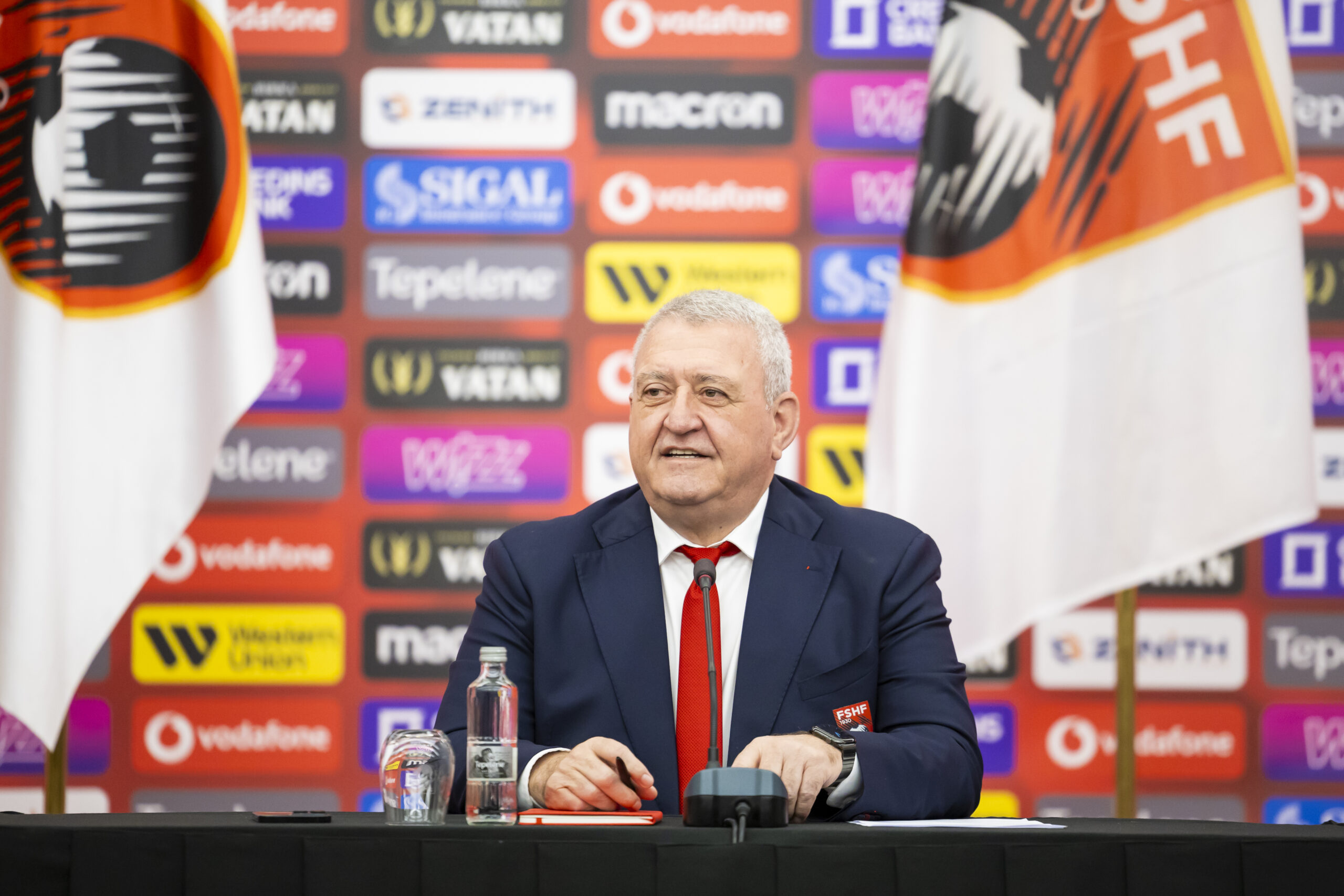
The President of the Albanian Football Association, Armand Duka, held a midday discussion with journalists, where he answered questions on various topics.
From the premises of the “House of Football,” the head of Albanian football addressed the progress and achievements of the national team, the future of coach Sylvinho, and ongoing discussions with him, as well as potential names that could replace him if no agreement is reached.
President Duka also spoke about the sponsorship law, the clubs in the “Abissnet Superiore,” the overall level of football, supporters, preparations for the UEFA U-21 European Championship finals, infrastructure development, relations with KOKSH, and refereeing.
– How have you seen 2025 for the national team? What will happen with the national team coach?
– We definitely expected more and, in my opinion, we also deserved more. With what we showed on the pitch in Poland, the competition overall has been good. The qualifying group matches, of course, also included games where we did not meet our expectations. During the qualifying campaign there were very good performances against direct rivals, as our objective was to finish second in the group, while we struggled with Latvia.
Against England, many teams in Europe find it difficult to perform well, but for 70 minutes at “Air Albania” the performance was good. For me, the qualifiers were successful. To take it a bit further and connect it with the coach and the national team staff, they are the best in history. In the European Championship we were first in the group, in the World Cup qualifiers second, which has never happened before. Of course, we wanted and dreamed of going to the World Cup. We could have gone from that match, at least tried in Stockholm, but luck was not on our side.
But based on this kind of mini-analysis, I spoke with the national team coach immediately after returning from the exhausting friendly match with Ukraine, because we were all injured, more than Ukraine, since they did not feel it as much as we did. And I told him the same things—that in my opinion your journey over these years has been positive. But a coach feels it himself and must feel it himself. A professional feels whether he can lead a team or not. This is a position that consumes you. Players who are not playing or are not called up are not very happy, and maintaining those balances, having strength and still energy, is felt most by the person in charge.
I asked him how he feels, whether he sees himself continuing to lead this team or not. I have a duty to be transparent and I am saying the conversations exactly as we had them with the coach. He asked me: “What do you think?” From my point of view I told him that you still have energy. He will take time to think and give me an answer. This does not mean that if he says yes, we will continue, because we will offer him the conditions of a new contract after July. But we will decide this before the June matches, whether we continue with the same coach or not, so it depends on both sides whether we continue with him or move on with someone else.
– A 6-month contract, was it your decision or the coach’s request?
– Perhaps the contract from the beginning should have been until March, at the end of the play-off matches, but since we had agreed on this contract and it was valid until November, and we qualified in November, we could not make a contract until March, because it would have been demotivating for the team. If the team saw a coach whose contract ends on March 31, we would be sending a message that we are not going to the World Cup, while we wanted to convey the message that we are going to the World Cup and that the coach’s contract is valid until after the World Cup ends.
The differences are very small and psychological preparation, belief in victory, are among the most important things. First is convincing yourself that we can achieve it, and then transmitting that to others. We have tried to convey this spirit to the team and the environment.
Someone might say they feel disappointed, because you told us we would go to the World Cup, but without transmitting this kind of energy it is difficult to achieve it. I don’t think we did badly, because as we saw on the pitch, we were really close to achieving it. So the reason the contract was until June was exactly this: to send the message that we will be at the World Cup.
– An Albanian coach at the helm of the national team?
– I have indeed offered at least once the position of national team head coach to an Albanian coach, who was Besnik Hasi. At the last moment, when we were close to finalising the contract, Besnik withdrew because he was offered the role of Anderlecht coach. Later, in all cases I have certainly considered it and I still consider it, but we will see.
But first, I have offered the current coach to express his opinion on whether he has the will, energy, and desire to continue. Then there are also the conditions, whether they satisfy both parties. This will be decided before the June friendly matches.
– Where do the talks with the government stand regarding the sponsorship law?
– I am convinced, but that is actually the reality, that without some kind of incentive or support, football in Albania will have financial difficulties and will continue to have financial difficulties. Financial difficulties not only at the professional level, in the top divisions, but also in grassroots football. It is very difficult for it to develop without some kind of incentive.
We started the discussion, the battle, the effort for the sponsorship law eight years ago, and we are still in the same situation. I am not in a position to say that it will be done. Promises have been made year after year that it will be done. We have had many meetings, negotiations, discussions, most recently also with the Minister of Sport, even after the Assembly, about 10–15 days ago, to go through the details of the draft. The government has in fact prepared a draft and sent it for public consultation, and some public discussion has taken place. We have made our comments, and of course we have many remarks about that draft. I hope it is in its final phase and that our comments will be taken into account.
We want it to be a functional law, one that truly helps and supports sport, because in the end this is a political will—whether we want to develop sport or not. Since this will has been expressed, the technicians must find the right path. The law faces strong opposition from the Ministry of Finance.
For me, this is an absurd opposition, because the question is where the money will go. This money will go to our children who will play football. Since it does not go directly through the budget, in a way, in the end all the money comes from our taxes and the budget distributes it anyway.
To have direct distribution from the budget to sport, we have a 36-year history where it has not happened, so the only mechanism left is the sponsorship law. I hope we are close to finalising it, but I cannot speak with certainty, because I am the one requesting it, not the decision-maker.
– How long will you wait to make a decision about the national team coach?
– I will wait very little. The first offer will be made to Sylvinho, and if it is not finalised, we will certainly start the same process, and it does not mean that I do not already have some names in mind.
– Do you agree with coach Sylvinho’s decisions during the qualifiers?
– I actually never fully agree with coaches’ decisions after the game. I always have my own thoughts, but I am not a football specialist in the sense that my opinions are necessarily right or true. In the end, the decision is made on whether he is the right coach, based on the sum of his decisions and selections.
We have done this analysis and, while not being 100% aligned with everything—whether technical or human—I have told him he has his shortcomings, just as I have mine. Overall, the balance is positive, which is why we have offered him to continue.
Then whether I agree or not—whether it should have been Bajrami or Uzuni, or otherwise, or whether Ajeti should have played (I wish him a speedy recovery), or it could have been Ismajli—these are personal decisions.
– There have been discussions worldwide regarding agencies selecting and managing players. How do you see this?
– These are things that are not new to us. They are common discussions. We should look at decisions, not prejudices. I have a positive assessment of the coach.
I completely reject any accusation that may be made. His selections have been objective.
I do not think that all of us here, or all our fans who support us, if they made the national team list, would differ by more than 5 percent from any of us. I do not have such a view at all.
– Have you had a meeting with Besnik Hasi, since he has been in Tirana in recent days?
– To be honest, I don’t know. These days my workload has been heavy and I really don’t know. I have met several former footballers these days, but not Besnik. Before we close this matter, we cannot start talks with others. Even though he has declined, of course. This is not a marriage, it is professionalism.
– Will the format of the Albanian championship change, not only in the Abissnet Superiore but also in the First Division?
– For the professional championships—Abissnet Superiore, the First Division, and the Second Division—we have certainly discussed this many times. At the end of each season, we analyze everything by looking at all the statistics. We even held an event at the FSHF where the Competitions Director presented all the championship statistics, both negative and positive, including the 10-team format.
In reality, it is a strong championship. This does not mean I am saying it is a very high-level championship, or a very beautiful one like the top 5 leagues in Europe, but it is strong, competitive, and unpredictable, where the last-placed team can beat the first. The characteristics of this championship are that the point differences between first and last place are not very large, unlike in some other countries with the same number of teams.
People often say we should increase the number of teams, and rightly so, because there are several big cities with tradition, history, and contribution to Albanian football that are currently outside. But if a city or club is not organized, does not invest, or is not interested, then whether you make it 10, 12, 14, or 16 teams, it will still remain outside. That is how the market economy works.
Even in the world, there are many traditional clubs playing in lower divisions or second tiers; the same applies here. The reason we should continue with 10 teams is because this championship is strong and increases competition for points. Almost until the final weeks, no team can afford to relax against another, and that is important for us.
In addition, the current financial resources available for football do not allow for more teams. In the current conditions, with four teams qualifying for Europe, the championship becomes even more competitive, because two are relegated, the third goes to a play-off, and four go to Europe. This prevents a gap in the middle that would otherwise harm the competition.
We have seen before what happens with 12, 14, or 16 teams. This format does not allow room for compromise, and that is important. In these conditions, with the current finances and without a sponsorship law, we will continue with 10 teams in the Superiore and 12 in the First Division.
– What is your comment on refereeing performance this season?
– We should say how satisfied we are overall with the competition, not based on one episode, one match, or one fragment. Of course, there are mistakes. I am even unhappy with the referee in Real–Bayern who gave a red card, because I was with Real and not Bayern (laughs). I am unhappy, but I cannot say whether the decision was right or wrong.
There are mistakes, but overall the level is not higher than football itself; it is at the same level. There are no errors that distort the competition. I do not believe that, at least in history or even in the current championship, teams that deserve to be higher have been placed lower because of refereeing mistakes.
As for decisions such as a team boycott or an individual one, boycott is the worst thing, especially in football. It is bad in all areas of life, but especially in our game. Whether the boycott comes from a correct or incorrect decision, it is condemnable.
The attitude of FSHF committees regarding boycotts has not always been correct in some cases, and this has led to at least three such cases in recent memory. About 80% of clubs have requested that we be stricter with boycotts, as this can do more damage. In the regulations for the next season, this issue may need more attention.
– How satisfied are you with the results of youth national teams?
– The commitment to national teams, both girls and boys, is maximum. The activities carried out to reach qualification matches are extremely extensive and frequent. The “Step by Step” program follows player development from early ages. We also have the “Elite Youth Academy”, which we started two years ago.
We are among the few federations that have an elite federation academy. There are gatherings, friendly matches, training camps abroad, and results are not the only thing that matters for national teams, but also what they can produce for the future. The system has indeed produced players, but sometimes we have short memory. People say the national team has no players from Albania or from youth systems, but in reality most of them are from youth systems, and almost half are from Albania and some from the domestic league.
We do not close the door; in fact, it remains open for talents developed abroad, because we have both the right and the duty to give them the opportunity to contribute to the national team. Results, although not the main objective, are still important for development, because positive results help players grow further. I do not agree that they are negative; they are just not the best possible.
In the last U-19 qualifiers, they finished with one win, one loss, and one draw in a very strong group. They should have won the last match against Norway as well, but missed a penalty. For the women’s teams too, we must be realistic about where we started and what resources we have.
Women’s football started in 2008, and today it is rising in level, playing in League B of the Nations League, or at elite youth level. Results are improving. We won the previous tournament with the U-19 girls in Albania, and recently played against three very strong teams where we are not at the same level, so overall the results are satisfactory and the development is not bad.
– What should we do differently to bring fans back to stadiums in league matches?
– We need better club organization. It is not that clubs do not want it, but financial possibilities are limited and we must accept that. This is linked to the law we discussed, which our competitors have and we do not. There must be an initiative that starts and allows a club to generate its own revenue and develop itself. For me, that is the first point.
The second point is the change of infrastructure in Albania. Sports infrastructure in Albania has practically been left as a responsibility of the Football Association, while in reality it is not its duty. Of course, within its means it can invest and it has built football pitches, but not enough for Albania. Today we have one football pitch for 18,000 inhabitants, while similar countries have one for 3,000–4,000 people. We have improved a lot, we have developed a lot, and our playing infrastructure is better than the region, but we do not have enough training pitches, which would increase mass participation and later quality. These are the things we must do better.
Infrastructure requires attention from central and local government. It is not enough for everyone to come to the FSHF and ask for a football pitch, because the Federation cannot build as many pitches as the country and our youth need. To fill stadiums, results and level are important. When a club performs well, as does the Albanian national team, fans come more. But this is not the only factor influencing attendance. We also see in Germany that in the fifth division the stadium is full.
I do not believe that in Germany’s fifth level the quality is higher than in our Superiore League. First we need better organization, better promotion, better conditions, better accommodation, fewer ultras and more supporters. All of this together must be improved, because it is the duty of clubs and the federation to better promote the competition I mentioned. It is not only the level that brings spectators to the stands.
– Which national teams are we in talks with for June friendlies, and is there a chance we play a friendly with Kosovo?
– We will play two matches in June. We have not yet finalized the contracts. We have almost agreed to play Luxembourg in Tirana. We are in talks with other teams for the second match. Most likely, the second match will also be played in Tirana. We could play Chile, Denmark, or another team. We have not spoken with Italy or Kosovo, as has been mentioned.
– The projects for new stadiums planned in several Albanian cities have been withdrawn. How do you see this withdrawal of stadium investment compared to the “100 pitches” project? Are you a supporter of stadiums or new pitches?
– The infrastructure for professional football activities is not bad. I believe that even if we had 4–5 or even 15 more stadiums, it would be even better. The projects started in Korça, Vlora, Durrës, and “Selman Stërmasi”, as far as I know, are still in process and ongoing. From a sporting point of view, we have delivered everything requested on time and submitted it, so I hope they continue. They have been somewhat delayed, but it seems that “Selman Stërmasi” will continue this year, as we checked whether it could be an option for training during the U-21 European Championship, and we were told work will continue.
Am I a “supporter” of pitches or stadiums? Our country today needs pitches, especially in more populated areas like Tirana. More than half the population lives in Tirana, and there is no space to build football pitches here. The “100 pitches” project continues. Those who apply are mostly in the periphery and other cities.
Of course, football is played everywhere, and we respond to those projects. Our project has no limits: even a private individual can take the initiative and we finance 50% of the project, whether natural or artificial grass. In Tirana, there is no space. If it were inside the outer ring, we could even finance 100% of the pitches.
– You said refereeing has not distorted the competition. Will “Final 4” be entrusted to Albanian referees or foreign ones?
– In previous years, a foreign referee was used to eliminate any prejudice or perception issues, since it was just a single final. But this year it will be a mini-tournament, not a single final, with matches starting on May 16 and ending on May 31 at “Air Albania” stadium, and they will be officiated by the best Albanian referees. The refereeing sector will assign the referees for “Final 4”, both for VAR and on-field officiating.
– If the national team has achieved results we have not seen before, what does it mean to you that our clubs are not managing to reach European competition group stages?
– In the last European season there has been some positive change compared to the year before. We have considered all ways in which we can help Albanian clubs reach at least the group stage of the Conference League, because they deserve it.
For financial reasons, clubs are forced to sell every talent that emerges as soon as they develop. As you have seen, players who grow up in our league quickly move abroad. We and the public only know a few players who reach higher levels, but there are many more who go from the Albanian league to Turkey, Romania, Ukraine, Russia. If finances were stronger, they would contribute more to our clubs and achieve better European results.
This is a major concern, because beyond image and positive examples, participation in the Conference League would also improve finances. We discussed this with clubs when we allowed an unlimited number of foreign players, hoping it would bring better results. Last year it was slightly better than two years ago. I hope this season will be better and that we will send teams into the Conference League.
– The final phase of the U-21 European Championship is approaching. Will Albania finally enter a new era regarding the coaching position?
– We have requested to host the U-21 European Championship next year, and it has been approved. We must prepare the infrastructure together with local and central government, as in some municipalities we are not at the expected level. In Shkodër, we have practically done nothing; we do not even have a natural grass pitch.
We need at least two natural pitches to be a city capable of hosting matches and accommodating teams. In the same way, we have started preparations with our team, friendly matches, selections, the same staff, and the same coach, in order to aim for success at the 2027 U-21 European Championship.