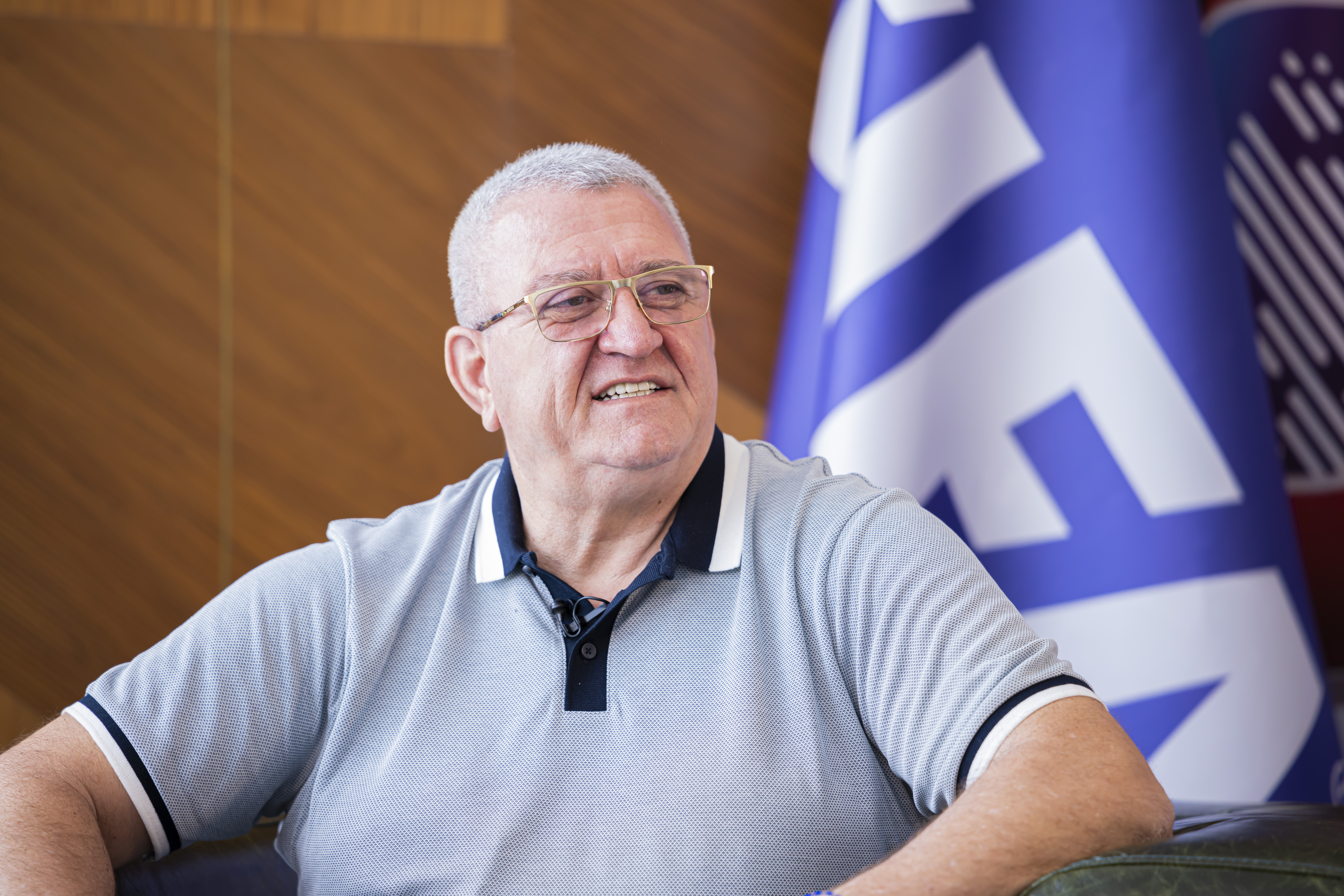
President Armand Duka was invited on the show “Sport News” on News 24, hosted by Trevisa Tufa. The head of the Albanian Football Association gave a summary of this football season, from the national team to the Albanian league, and the organization of the U-17 European Championship. President Duka also commented on the recent changes in the sports law approved without any consultation with sports interest groups. He spoke about the dream of the “2026 World Cup” as well as the “Final 4” format.
— President, you seem calm and in good shape. Was this a positive year? Did the AFA earn a lot of revenue?
— I think it is something positive; every year the revenue level grows, the level of football improves, and consequently, there is more business.
— The biggest challenge, at least for organization, I think was the match against Serbia. Were you ever afraid something might happen? Or what would you highlight?
— If I were to rate it from 1 to 10, I would give it a 7, generally successful from an organizational point of view. The commitment was maximal, from the State Police and all Albanian institutions. to have everything well organized. I would say 70% was well executed.
— I believe you also gained a lot as a Association, both financially and in reputation with UEFA and FIFA. However, it seems like we’re losing fans, President. How will you solve the ticket lottery or ticket prices?
— Certainly, there will be satisfied and dissatisfied people. The important thing is that everyone has an equal chance to be in the stadium. Prices are a market issue—if the market accepts, demand is high. We are a sports organization. We could, for goodwill, make tickets free, but our team cannot operate without money. The team has no income and no contributions from anyone, not even the Albanian government. We receive zero from everyone. The only sources where we have achieved positive results, participating twice in the European Championship, are ticket revenues, TV rights, and sponsors, which we have increased a hundredfold. To be populist, I would want tickets to be free. Today, we don’t know a better way than this to distribute tickets fairly. I know this hurts some, I know there are groups who have always supported the national team and want privileges or priority rights for the stadium, but this system will continue as is.
— Another important and historic event was EURO 2025 for U-17. What was the most significant congratulation? Did UEFA colleagues promise you another event?
— It was good news. We had some emotion or uncertainty whether we really knew how to organize it. It turned out to be a very well-organized championship. What pleases me most are the thanks from the teams participating in the European Championship. The participation was satisfactory. The average number of fans was 4,700 spectators, not a record but second place after Germany in 2018. It really was a good organization and a test for another event. Now we are in another world, and the U-21 organization format will be different in 2027.
— How would you rate this Albanian championship season? Are you satisfied?
— For me, the Albanian championship is perfectly organized. Like few regional championships, it is broadcast 100% live on television. The championship is refereed 100% with the VAR system. The number of spectators has increased. There is competition among clubs, a balance between stronger clubs and unpredictability. I would rate it truly positive. It has created more revenue. Sport-wise, every year it gets better, and I believe in European competitions, it will also show progress. Competition with other sports is good because we don’t have a competing sport; we compete with television broadcasts. In Albania, all other European leagues: Italy, Germany, England are watched. Matches are played on the same days, but we will try to make a schedule to avoid clashes with major European matches. We want to promote and organize better. I’m sure next season we will have 20% more fans in stadiums.
— President, it seems like you lost the most important match with the Olympic Committee (KOKSH); the parliament approved the changes proposed by Fidel Ylli. So, parliament voted for KOKSH, not you. Does this worry you?
— What worries me is how the law was prepared, how it was then approved, and ultimately became law—without any consultation with any sports interest group or representing any sports organization, but just an individual’s interest. I don’t know what urgency there was in these hot days, who requested this emergency except the KOKSH presidential candidate, to approve it now, in summer days. One of the arguments I gave to the Minister of Education is that Albania aspires and hopes to join Europe. To join Europe, we must align legislation with European legislation. Why make an urgent change in the law, which has been changed many times, each time when people with political influence have their interests? We are on the road to Europe; they should consult the law with European partners, UEFA, FIFA, and the International Olympic Committee to make a law that serves sports. They didn’t listen, but that doesn’t mean we will stand idle. We will make legal and public efforts to change it and do things that serve sports.
— Do you think there is something hidden behind this rush?
— We are not worried about the institution’s interest. The law gives the Olympic Committee the right to organize activities. This changes previous behavior. By law, a federation is an organization the state grants the right to organize activities. The state can take this right away. Now, it has created a parallel organization where the Olympic Committee has the right to organize. If it wants, tomorrow the Olympic Committee can organize wrestling, cycling, football, whatever. The law also creates a sports arbitration court where conflicting parties will be athletes, clubs, federations, and the Olympic Committee itself. The latter will appoint referees, with the ministers claiming Fidel won’t appoint bad referees. Let’s hope.
— Is there anything personal between you and Mr. Fidel Ylli? It seems like you only share the online betting law?
— There is nothing personal, except different concepts about organizing KOKSH. Regarding the betting law, we gave our opinion, which may have coincided with others. Even now, betting has existed and exists. We have said since this activity is done unofficially, let’s make it official and let football benefit. There is no coordination with anyone else. Betting is active; sport does not get money from it. I would be happy if betting was banned altogether because betting is a social problem for many people and families.
— You have been very close to Prime Minister Rama lately, together in Munich at the Champions League final. Didn’t you discuss the sports law with him? Are you happy that FSHF has government support today?
— I have not discussed the law with the prime minister. We enjoyed the match. During this period, I don’t know if he is informed or understands how much damage this law does to sport. I don’t believe our principled stance for the good of sport harms the Federation’s relations with the government. We care about partnership, and we have had it in organization and investments, and we will continue.
— Ironically, Erjon Braçe, a strong voice against you, did not vote for these changes…
— I don’t know the reason, and I don’t know if he voted. If he understood something, that is a positive development.
— There were some frictions with the Ministry of Education even before these changes were voted on during the Assembly. You asked them to keep their promises. Do these clashes risk not realizing Euro 2027 for U-21 or other events?
— Nothing personal, nothing individual. The Ministry of Education promised 20% of that budget of about 4 million euros spent on improving sports infrastructure; the ministry promised to support us with 1.1 million euros, which has not yet been fulfilled. We face a tougher championship ahead. If we have time until September, when the first organizing meeting is, we will say whether we can organize it or not.
— Now we are at a very important part of the Federation, the museum with many trophies. But what is missing? What would you like to add as a leader? What achievements?
— There are many things I think we should achieve or improve. To have more people playing football, we must work much more on training, preparing specialists who train footballers. We must promote better and improve infrastructure. I don’t just dream of a World Cup, but I see it as motivation for footballers and to see many more green fields with children.
— Satisfy my curiosity: between the two European Championships we participated in, which would you choose? Which was the best for you?
— 2016 is historic because it was our first participation. It was very beautiful, unfortunately only 3 matches. Germany 2024 was even better, in every aspect—sportively and in public support. It really is a championship, a tournament I liked. Our team seemed equal to others, although we got fewer points than in 2016. We faced some very good teams.
— Infantino, Ceferin, and other European association presidents have come here. What is your plan?
— My plan is to help the Association as much as possible. If I do that, I’m very happy. I do not aspire to anything more.
— You were recently in the USA for the Club World Cup, and in 2026 we will go to America. Do you still believe?
— I have never considered it an easy objective. It’s not easy but never impossible. Conditions have become tougher, but not closed. We have 4 matches to consider as finals. With a positive result in Serbia, we open the possibility for a Play-Off. It remains a difficult objective, not only now but also for the future. But we must aim for it. Our team deserves to aim because it has potential.
— You trusted Sylvinho again. What convinced you?
— Sylvinho is a dedicated person, someone who has contributed. There are no ideals; the only ideal is God.
— Final question about the future. Why continue with FINAL4? Why trust FIFA’s figures? Do you have plans to change?
— In its early stages, Final Four produced well, attracted more interest, emotion, and revenue. If it should remain like this, we are discussing with the competing members, football clubs, and experts whether to keep it the same, by dropping points of the top 4 teams, or by keeping points gathered during the championship, or halving them. We will decide this within 10 days with the participating teams.
— Where does the AFA president spend holidays, inside or outside Albania?
— Generally, in Albania, at the seaside.
— On beaches, I see grandparents holding their grandchildren while parents sunbathe. Do you belong to this category, Mr. Duka?
— I really want to have them with me. This year I don’t have the luck because their mother doesn’t let us.
— With so many commitments, do you have time for family? How do you balance it, it seems like you live between London and Albania?
— I think I manage quite well to be 60% a good family man.
— Where do you see yourself in the future?
— After finishing my Association duties, I hope to have rest—not because life allows me free time; I will work in business.
— In Albania, people deal with rumors. For example, what was the most absurd rumor about you?
— I hear a lot about me regarding business and football.
— When you read online comments saying “Duka will never leave,” do you laugh or get upset?
— I see my relationship with myself in two worlds: people on social media say many things, and people I meet on the street and sports environments have positive appreciation. I don’t know what the truth is.
— Is it harder to manage an important match for Albania or a dinner with political leaders at the same table?
— The hardest thing is to manage emotions at a high level.
— How hard is it to say “no” in your position? And do you use that word often in official meetings?
— I definitely say it.
— If one day you left your job and had free time, what would you do first? Or would you disappear?
— I would never disappear as long as I have the chance to be active. I said, if I am not active in football, I will be in business. Why not in another field.