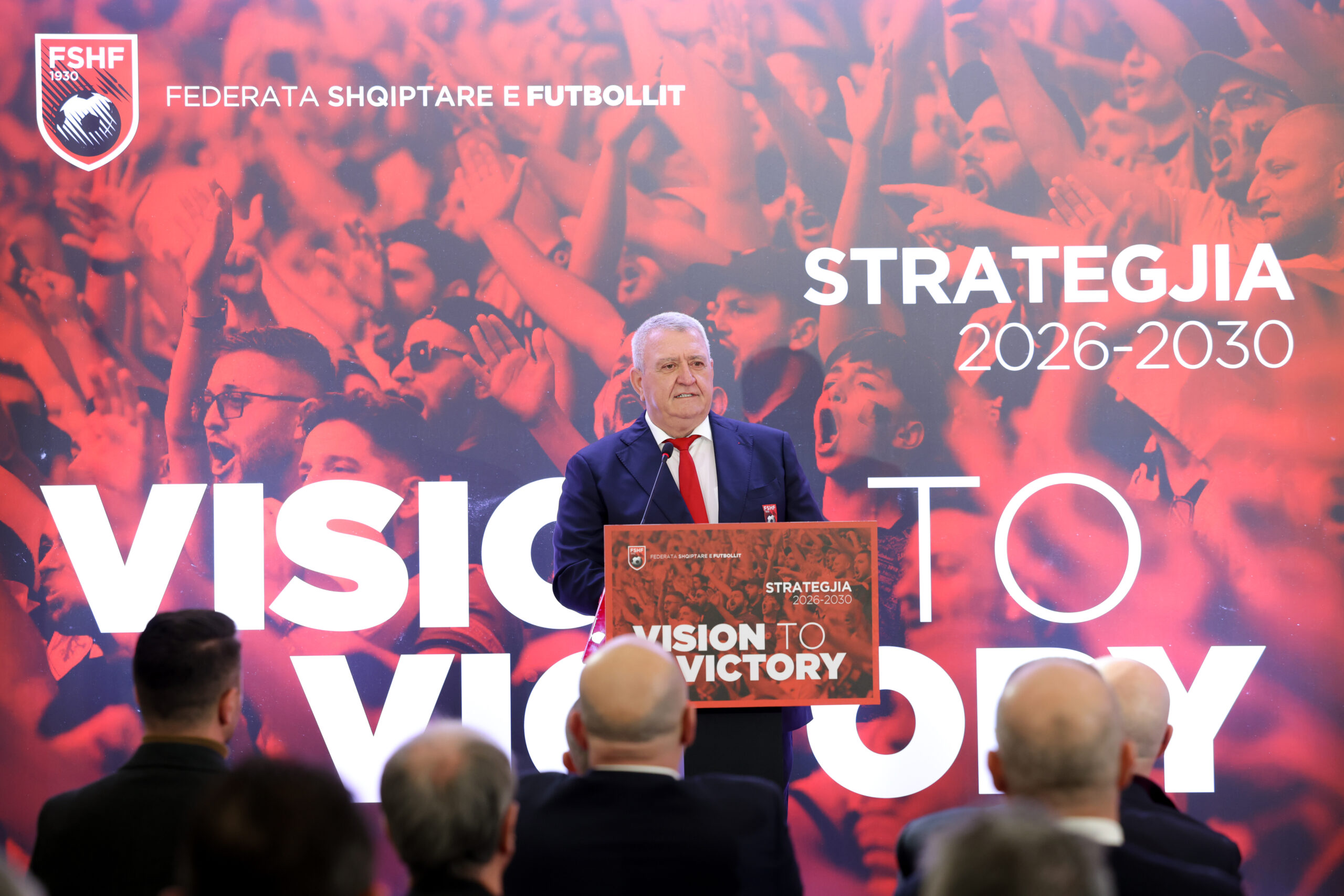
At the presentation of the “Vision to Victory” strategy, President Armand Duka delivered a comprehensive speech outlining the vision, objectives, and key priorities for the development of Albanian football over the next four years.
Reflecting on the previous strategic cycle and the challenges ahead, President Duka emphasized that approximately 95% of the objectives of the “Football for the Nation 2022–2025” strategy have been achieved or are in an advanced stage of implementation, describing this period as a solid foundation for taking the next step forward.
He further highlighted that the new “Vision to Victory 2026–2030” strategy has been designed to be measurable, implementable, and directly connected to the reality of Albanian football, setting clear objectives for participation, performance, infrastructure, education, and governance.
Below is the full speech delivered by President Armand Duka at the presentation of the “Vision to Victory 2026–2030” strategy:
Dear representatives of the Albanian football community,
Dear partners, friends, and collaborators,
Representatives of institutions, coaches, athletes, and football enthusiasts,
Honorable Minister of Tourism, Culture and Sport, Mr. Blendi Gonxhja,
Good evening and welcome to this special and highly important night for the Albanian Football Association and for the entire football community in our country. Today, we have both the pleasure and the responsibility to present to you the development strategy for Albanian football for the next four years, 2026–2030.
The Federation, now a consolidated institution, has built its development path with care, dedication, and courage. Nothing has been left to chance. Every objective, every step, and every decision has been planned on realistic foundations, based on concrete needs, existing capacities, and opportunities for development. This has been our working philosophy, and it has guided us throughout our journey.
In 2022, we presented the “Football for the Nation” strategy, an ambitious yet realistic document that set clear objectives and defined a concrete path for achieving them. The strategy was developed in detail, divided into clear areas of action, with measurable objectives and clearly defined responsibilities. It did not remain merely a guiding document; it was respected, followed with dedication, and implemented in practice, producing concrete results reflected in the video material we just viewed.
One of the main objectives of that strategy was increasing participation in football. We aimed to reach 23,000 registered male players and 4,000 female players. This objective was fully achieved, 100% overall, exceeded for male players and achieved at 50% for female players, clearly indicating both progress made and the work still ahead, especially in the development of women’s football.
This growth did not happen by chance. It was the direct result of projects implemented in schools, academies, and clubs; improvements in sports infrastructure; free material support for children; and the quantitative and qualitative growth of football coaches.
In women’s football, the “Rising Star” strategy produced concrete results: a continuous increase in the number of players, the creation of regional leagues and festivals, structured talent identification programs, Vllaznia’s qualification for the UEFA Women’s Champions League, and a television broadcasting agreement—significantly increasing visibility and professionalism in this sector.
During this four-year period, specialists and leading figures from Albanian and European football contributed to the education of 2,340 new coaches, from UEFA C to UEFA A and UEFA Pro levels. To bring these programs closer to communities and serve as models for sports academies, training sessions were held not only in Tirana but also in Shkodër, Durrës, Elbasan, Fier, Lezhë, Korçë, and Gjirokastër.
Another important objective was related to the performance of national teams, both men’s and women’s.
The senior women’s national team first earned promotion from League C to League B of the UEFA Nations League and, in the following edition, successfully maintained its place in League B, positioning itself among Europe’s more competitive teams.
Meanwhile, youth national teams partially achieved the objective of reaching the Elite Round, while the U-17 men’s national team participated in the finals of the European Championship hosted in our country, an extraordinary experience for players, staff, and Albanian football as a whole.
The most significant objective of the “Football for the Nation” strategy was qualification of the senior men’s national team for a major final tournament, either the European or World Championship. This objective was achieved and exceeded, as the national team qualified for UEFA EURO 2024 in Germany and is currently competing in the play-offs for the 2026 FIFA World Cup, writing a new chapter in the history of Albanian football.
Achieving football objectives is impossible without strong infrastructure. This was one of the main priorities of the strategy. Our goal was to build 100 new football pitches. Due to various factors, around 40% of this target was achieved. Strategic partnerships resulted in total infrastructure investments of €16,503,145, of which €6,764,793 came from Federation projects and the remainder from partners.
More than 40 new football pitches were built, along with five major stadium projects: Egnatia, Partizani, Vora, Gramsh, and Besa Kavajë (currently under construction). For the first time, a national audit of sports facilities was conducted, now serving as a basis for rational investment planning. The “House of Football” has been consolidated as a national center of excellence for education, training, and administration.
To achieve these objectives, modernization of governance, increased transparency, digitalization of processes, and high professional standards were essential—and all were achieved and surpassed.
Today, we can confidently say that we have built a functional, efficient, and trustworthy administration that has taken sustainable steps toward institutional modernization and professionalism, aligned with UEFA and FIFA standards.
We have also strongly focused on strengthening football’s social role, as a tool for education, integration, and inclusion—through community projects, inclusive programs, and social initiatives, achieved with pride through partnerships and stakeholder cooperation.
The Federation has successfully transitioned from fragmented initiatives to a structured and functional system, fully achieving the objectives of the “Football for the Nation” strategy.
At the conclusion of this four-year cycle, we can responsibly state that 95% of these commitments have been achieved or are in advanced implementation.
This leads us to a clear conclusion:
the “Football for the Nation” strategy was followed, implemented, and produced concrete results.
Based on these results and the current situation in the country, we now present the new “Vision to Victory 2026–2030” strategy, designed to be measurable, implementable, and directly connected to the reality of Albanian football.
A clear priority is the development of human resources. By 2030, we aim to increase licensed coaches by 30%, continue UEFA C courses nationwide, and consolidate UEFA A and UEFA Pro programs. At the same time, we will increase both the number and quality of referees and strengthen the professionalism of sports executives and administrative staff.
In governance and digitalization, our goal is for all key administrative and sporting processes to operate fully digitally and data-driven, enabling better reporting, more accurate decision-making, and increased transparency for clubs, academies, partners, and the public.
By 2030, we aim to increase the number of registered male footballers to 26,000, up from 24,078 today, despite demographic challenges. This growth will come through expanded school and community programs, strengthened regional associations, direct support for youth clubs, more organized activities for children and young people, improved infrastructure, and continued projects such as “Uniforma Ime” and “Topi Yt”.
Special attention is given to women’s football. By the end of the strategic cycle, we aim to increase registered female players by at least 50%, through financial incentives for clubs, expanded competitions, talent identification programs, and increased visibility.
The strategy also aims to build a unified national talent development system, with elite academies and professional clubs working under shared training methodologies, increasing the number of Albanian players in elite European leagues and ensuring youth national teams remain competitive in UEFA final stages.
In infrastructure, by 2030 we aim to add 30–40 new football pitches through Federation projects, mainly in the Tirana region, improving the population-to-pitch ratio—currently 1 pitch per 18,981 residents, compared to 1 per 3,800 in more developed European countries.
However, the real national need is the construction of 200 new football pitches, which requires state budget support.
Another key strategic objective is increasing stadium attendance across all national competitions, in cooperation with professional clubs and academies.
Financial sustainability is equally important. The strategy aims to grow commercial revenues and build long-term partnerships to ensure sustainable investment in grassroots football, talent development, and infrastructure.
Strengthening the financial position of clubs and academies remains crucial. Development will be slow without financial support and incentives. We will continue direct financial support, €3 million in 2026, and work with the Government to finalize the Sports Sponsorship Law, without which progress will be limited.
National team objectives remain:
-
Qualification of the senior men’s team for European and World Cup finals and achieving a top-50 FIFA ranking.
-
U-21 team advancing past the group stage at Euro 2027 (hosted in Albania) and qualifying for Euro 2029 finals.
-
Maintaining the women’s national team in League B and aiming to qualify for Euro 2029 in Germany.
These objectives will be supported by annual action plans, performance indicators, monitoring, and public reporting—because strategy is measured by what is achieved on the field.
I thank Minister Blendi Gonxhja for his cooperation and commitment, and I firmly believe that together we will realize the long-awaited sponsorship law.
I also thank UEFA experts, the UEFA GROW team, AFA staff, regional associations, clubs, and all partners involved.
“Vision to Victory” is an open invitation, to unity, ambition, and belief.
Only together can we turn vision into victory, not only in sporting results, but in a football system that develops people, communities, and our country.
The next four years will be decisive. With dedication, professionalism, and cooperation, I am confident we will take Albanian football to a new level.
Let us build this journey together.
Let us turn “Vision to Victory” into shared success.
Thank you!